Rahul Sajnani

I am a CS Ph.D. candidate at Brown University advised by Srinath Sridhar, graduating Dec 2026. I build generative world models for robot learning — unifying video, action, and language into one representation so robots can plan, remember, and act end-to-end from pixels.
Previously: Applied Scientist II Intern at Amazon Robotics (2024–2026), Research Scientist Intern at Adobe Research (Summer 2025), and lead of the self-driving car perception stack at RRC, IIIT-Hyderabad. B.Tech + M.Sc. (ECE Gold Medal) from IIIT-H.
I am on the industry job market (2026) for research roles in robotics foundation models, autonomous driving, and generative modeling (also curious about brain–robot interfaces).
Research focus
- Controllable generative models — steering diffusion internals for geometry, 3D, and multi-region control. [GeoDiffuser · WACV '25 Best Student Paper, AppearancePointers]
- Canonicalization & 3D understanding — SO(3)-equivariant pose estimation on partial shapes and NeRFs, feed-forward 3D Gaussian Splatting from monocular video via video-diffusion priors (Wan2.1, LTX-Video, CogVideoX), regularity-aware scene composition, and dense reconstruction. [ConDor, Canonical Fields (CVPR Highlight), LEGO-Net, DRACO]
Also curious about brain–robot interfaces: using generative priors to decode intent from neural signals into robot action. Open to collaborating / joining a team already working here.
Collaborators & mentors: Srinath Sridhar, Leonidas Guibas, George Konidaris, Daniel Ritchie, Jeroen Vanbaar, Kapil Katyal, K. Madhava Krishna, Matheus Gadelha, Kavita Vemuri.
Google Scholar / Email / GitHub / X / LinkedIn / ResearchGate
Featured News
| Oct 19, 2026 | I am on the industry job market! Looking for full-time research roles in robotics foundation models, autonomous driving, generative modeling, and brain–robot interfaces. Reach out. |
|---|---|
| May 12, 2025 | I received an Outstanding Reviewer award at CVPR 2025!  . |
| Apr 02, 2025 | Our work GeoDiffuser received the Best Student Paper at WACV 2025 ! Read article for more information. |
| Oct 28, 2024 | Our work GeoDiffuser is accepted to WACV 2025 ! See you in Arizona! We perform geometry-based image editing with T2I diffusion models without any training or model / fine-tuning. |
| Oct 24, 2024 | I will present literature on Video Diffusion Models with a focus on camera/motion conditioned models at Brown IVL & BVC. See slides here. |
| Apr 01, 2024 | I will present GeoDiffuser, a method to perform geometry-based image editing with T2I diffusion models at NYC Computer Vision Day. Our work does not need any training or model fine-tuning! |
| Jun 24, 2023 | I will join Amazon Robotics as an Applied Scientist to improve robot perception and item identification using Generative models. |
| Jun 20, 2023 | Check out our works Cafi-Net & Lego-Net at CVPR 2023! |
| Jun 01, 2022 | We will be presenting ConDor, a method to perform unsupervised 3D pose canonicalization of full and partial shapes at CVPR 2022. Our work also performs automatic co-part segmentation! |
Featured Publications
-
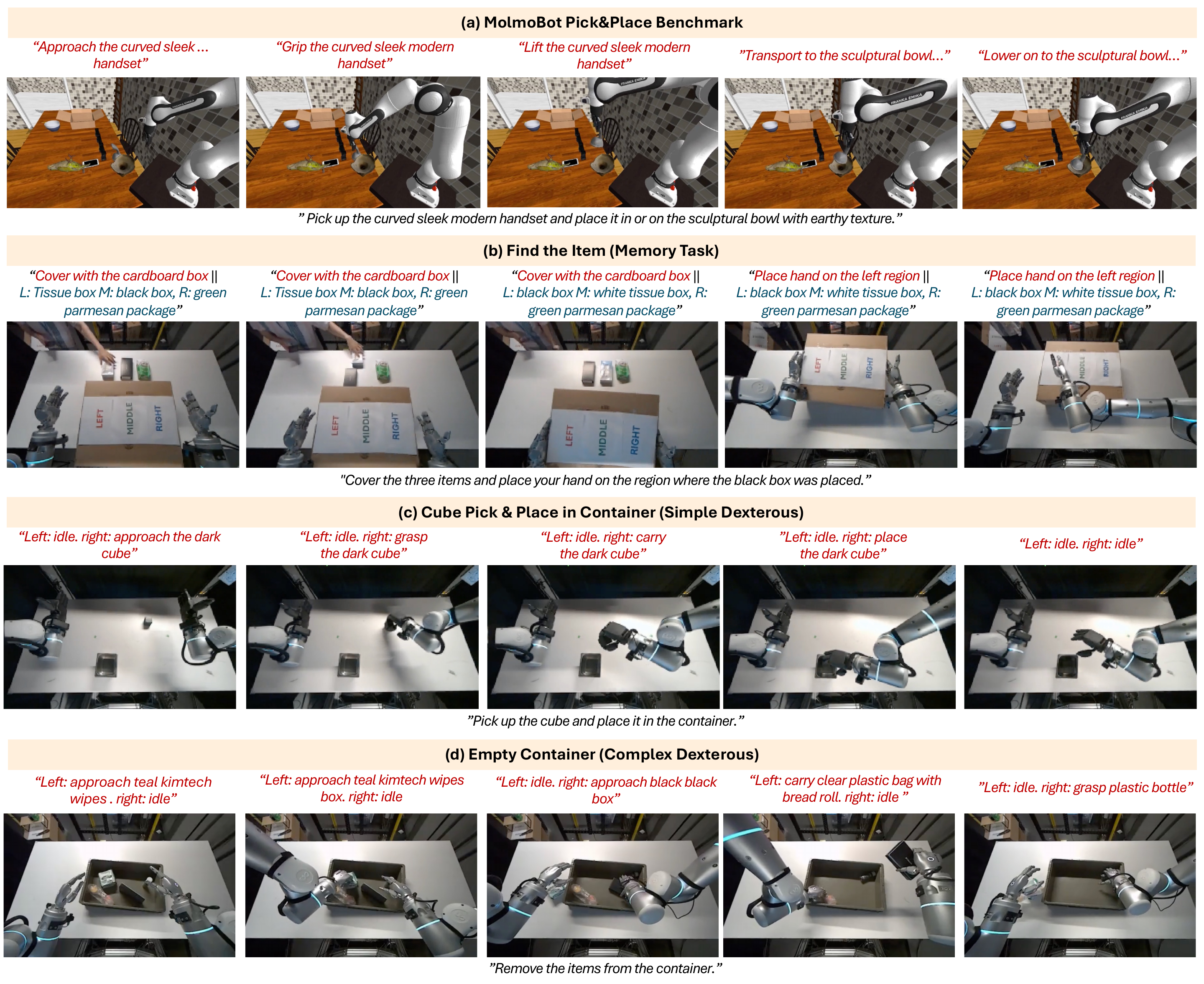 UniWALM: A Unified World-Action-Language Model for Embodied Robot ControlIEEE International Conference on Robotics and Automation (ICRA) (Under Review), 2027
- Mixture-of-Transformers (Wan2.2 video + action DiT + discrete-diffusion language expert) co-generates video, action, and language in one parallel diffusion pass.
- Policy re-reads its own generated language as memory on every control step — no external VLM / planner.
- Real-world memory-dependent manipulation: 11.1% → 61.1% vs same-backbone FastWAM.
- 34.5% on RMBench, above Mem-0’s privileged-keyframe setup (28.5%).
-
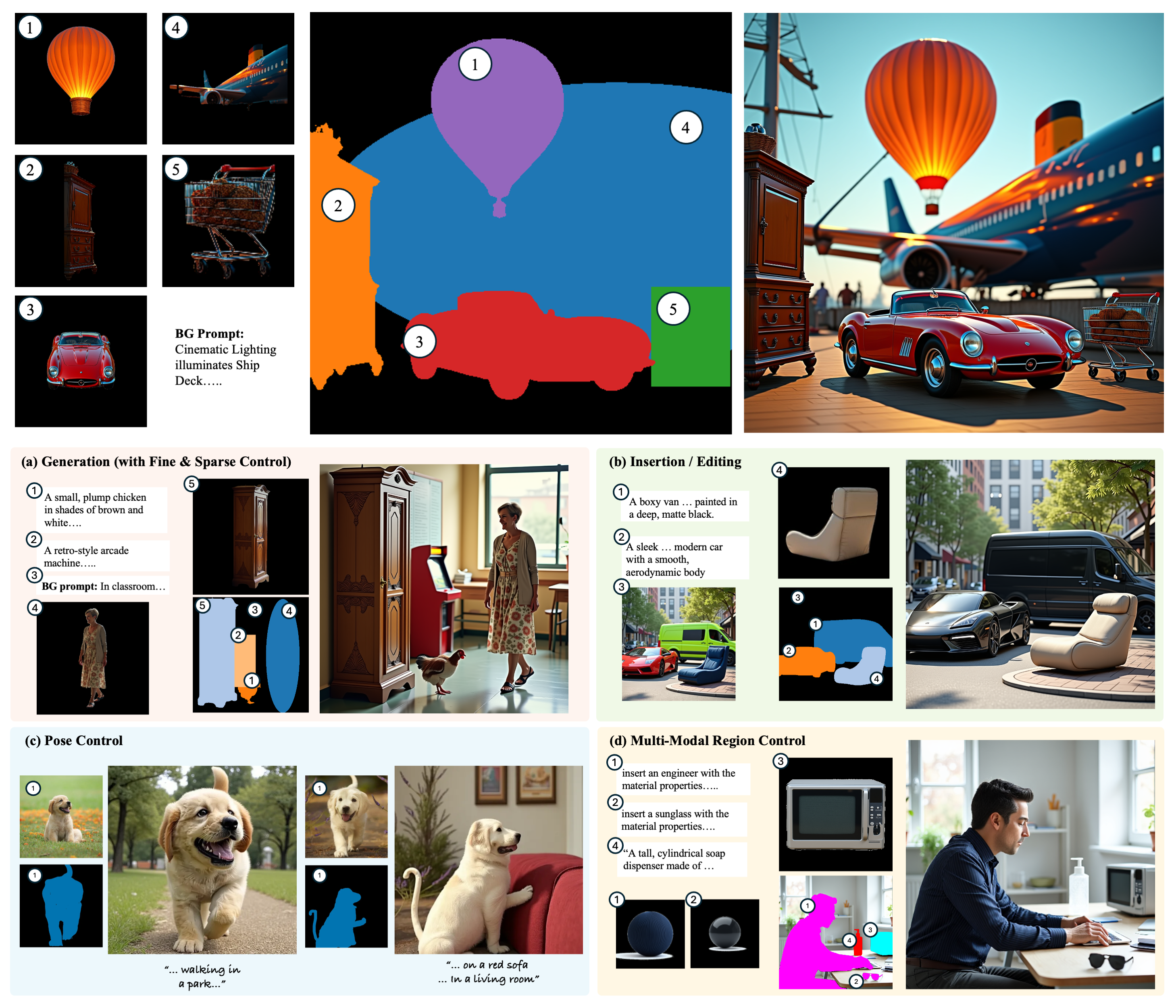 AppearancePointers: Fine-Grained Multi-Region Control with Appearance PointersInternational Conference on Learning Representations (ICLR), 2027 (Under Review), 2027
- FLUX-based model for multi-region controllable generation: each output region independently steered by text, reference image, and material texture in a single denoising pass.
- State-of-the-art on three multi-region fidelity metrics, beating DreamRenderer and MSDiffusion at larger scale.
- Introduces the curated AP-37K multimodal dataset.
-
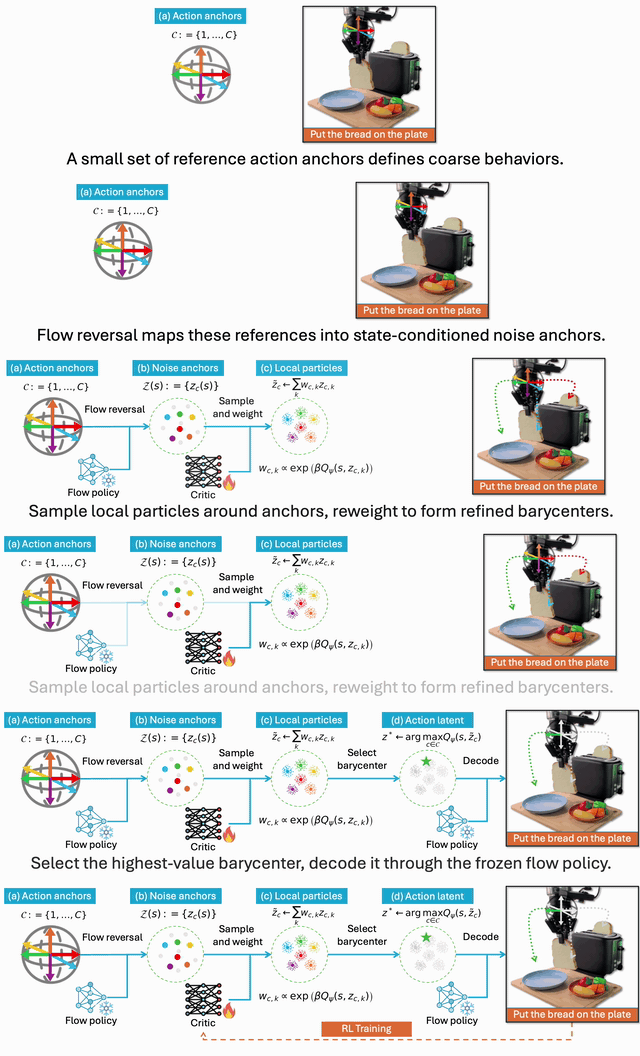 Sample-Efficient Reinforcement Learning for Policy Improvement via Flow-Reversed Action AnchorsInternational Conference on Learning Representations (ICLR), 2027 (Under Review), 2027
- Sample-efficient RL fine-tuning of generalist robot policies using flow-reversed action anchors.
- A diffusion-policy improvement scheme that sharply reduces costly online interaction.
-
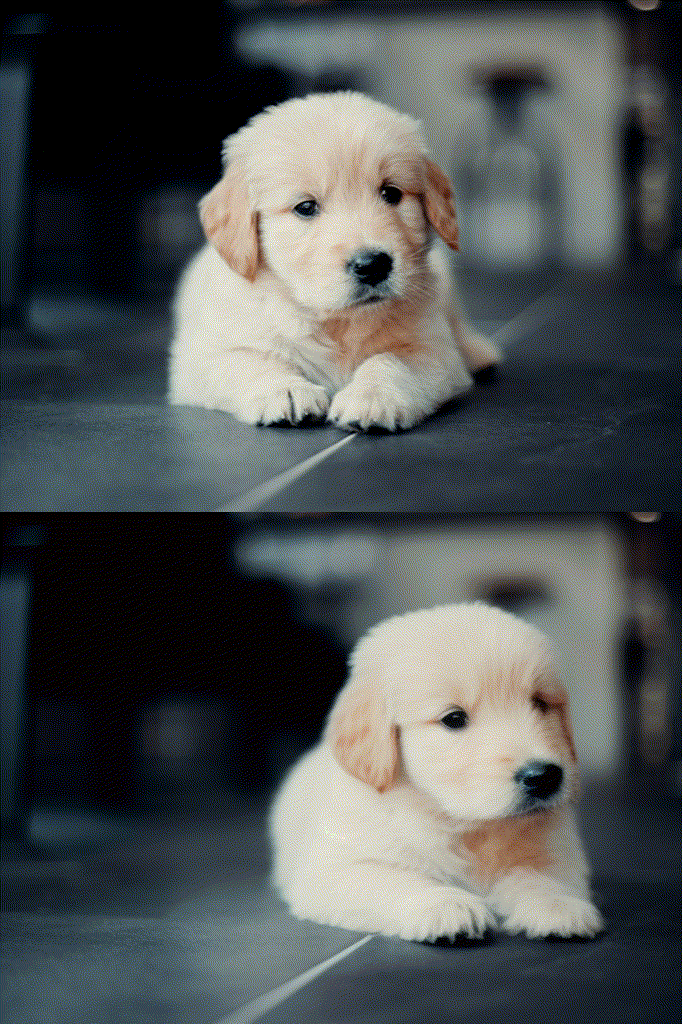 GeoDiffuser: Geometry-Based Image Editing with Diffusion ModelsIn Proceedings of the IEEE/CVF Winter Conference on Applications of Computer Vision (WACV)(Best Student Paper) , 2025
- Training-free geometry-based image editing on a frozen T2I diffusion model.
- User specifies a 3D rigid transform (rotate, translate, scale); GeoDiffuser rewrites attention maps to realize it.
- No fine-tuning, no 3D supervision — WACV 2025 Best Student Paper.
-
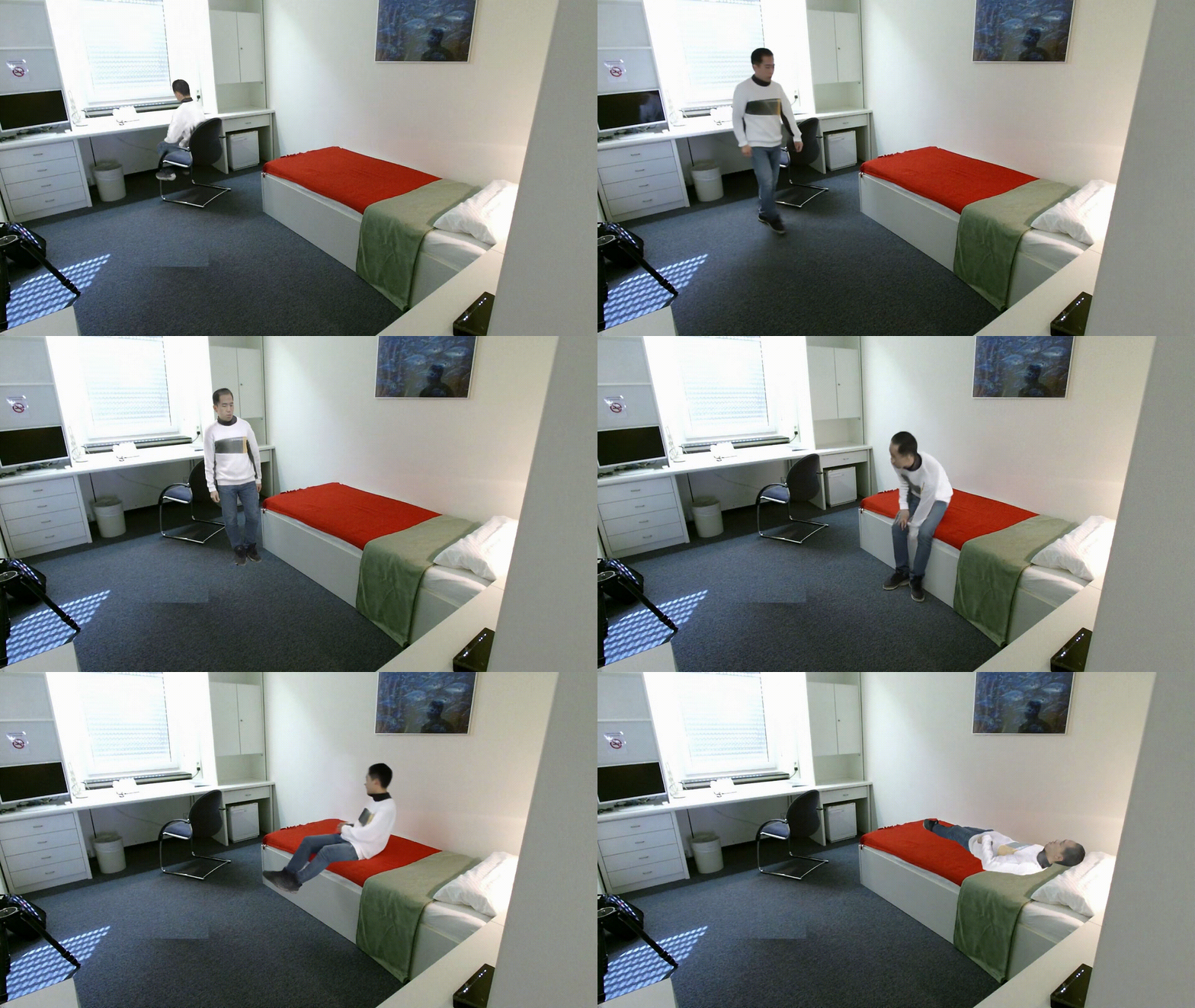 GenHSI: Training-Free Controllable Generation of Human-Scene Interaction VideosIn Proceedings of the IEEE/CVF Winter Conference on Applications of Computer Vision (WACV), 2026
- Training-free controllable generation of human–scene interaction videos.
- Uses a video-diffusion prior with per-region controls — no retraining for new scenes or humans.
-
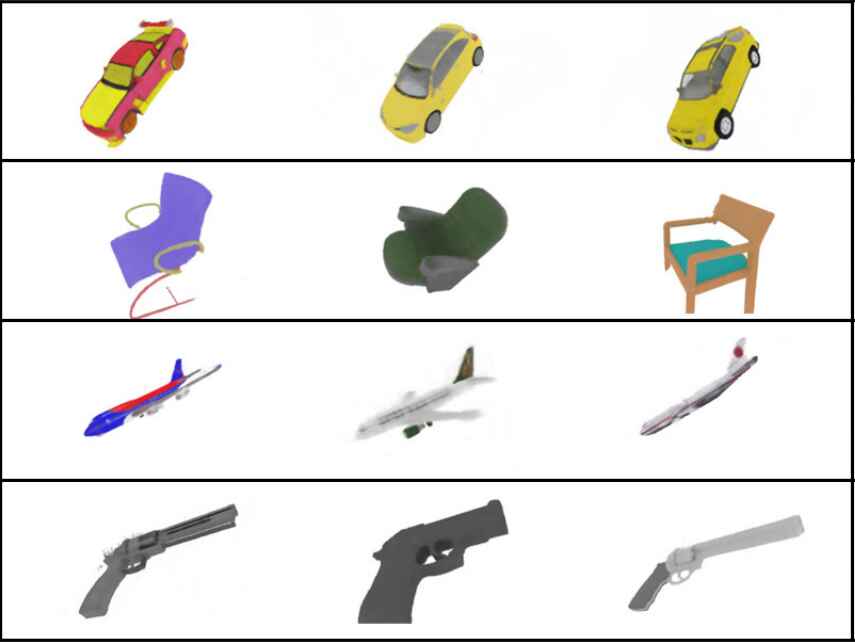 Canonical Fields: Self-Supervised Learning of Pose-Canonicalized Neural FieldsIn Proceedings of the IEEE/CVF Conference on Computer Vision and Pattern Recognition (CVPR)(Highlight) , Jun 2023
- Self-supervised learning of pose-canonicalized neural fields (NeRFs).
- Discovers a canonical frame for an object category without any pose or 3D supervision.
- CVPR 2023 Highlight.
-
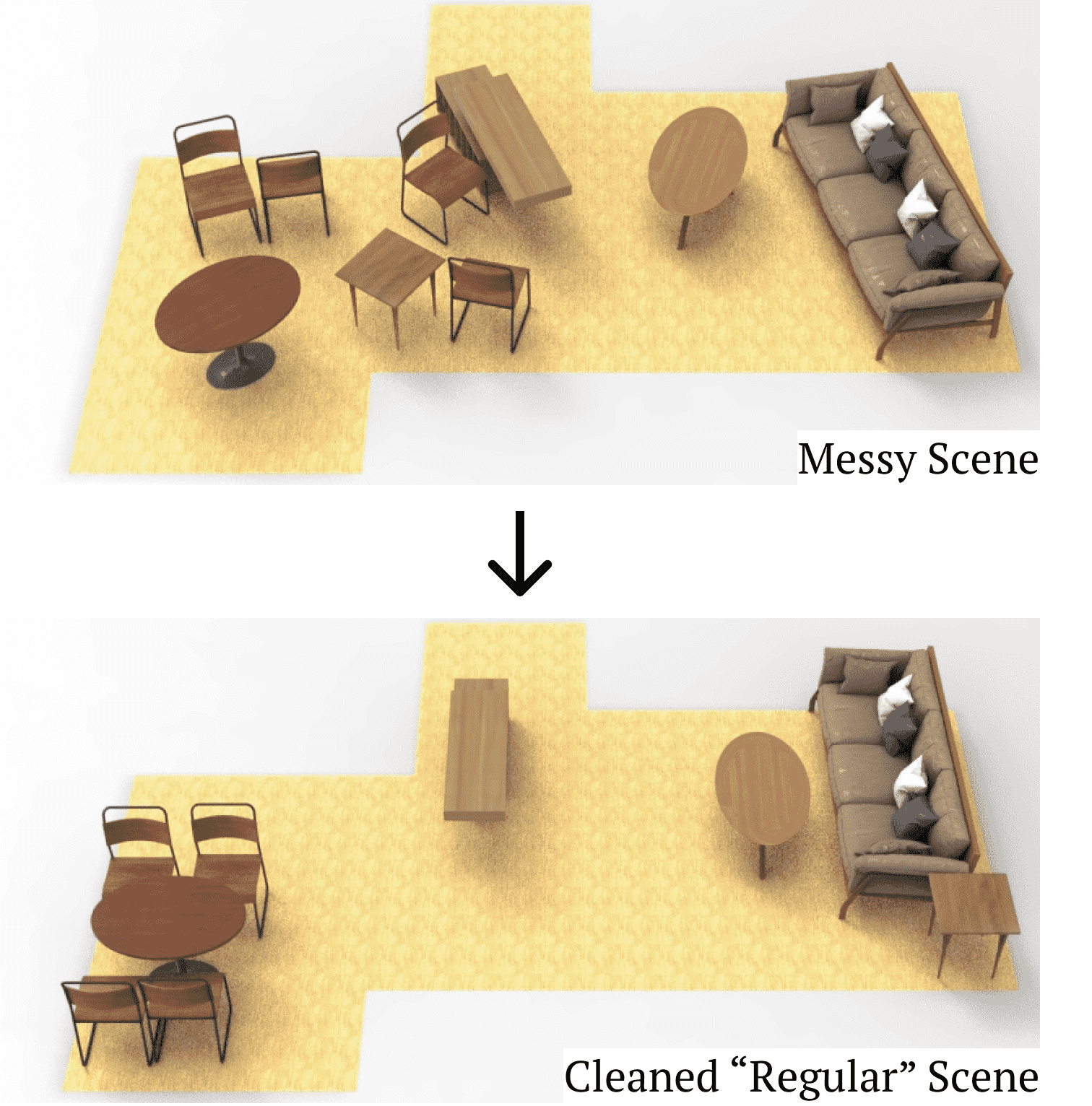 LEGO-Net: Learning Regular Rearrangements of Objects in RoomsIn Proceedings of the IEEE/CVF Conference on Computer Vision and Pattern Recognition (CVPR), Jun 2023
- Learns to rearrange cluttered rooms into regular layouts using a diffusion-based scene editor.
- Discovers regularity patterns (alignment, symmetry) directly from indoor-scene data.
-
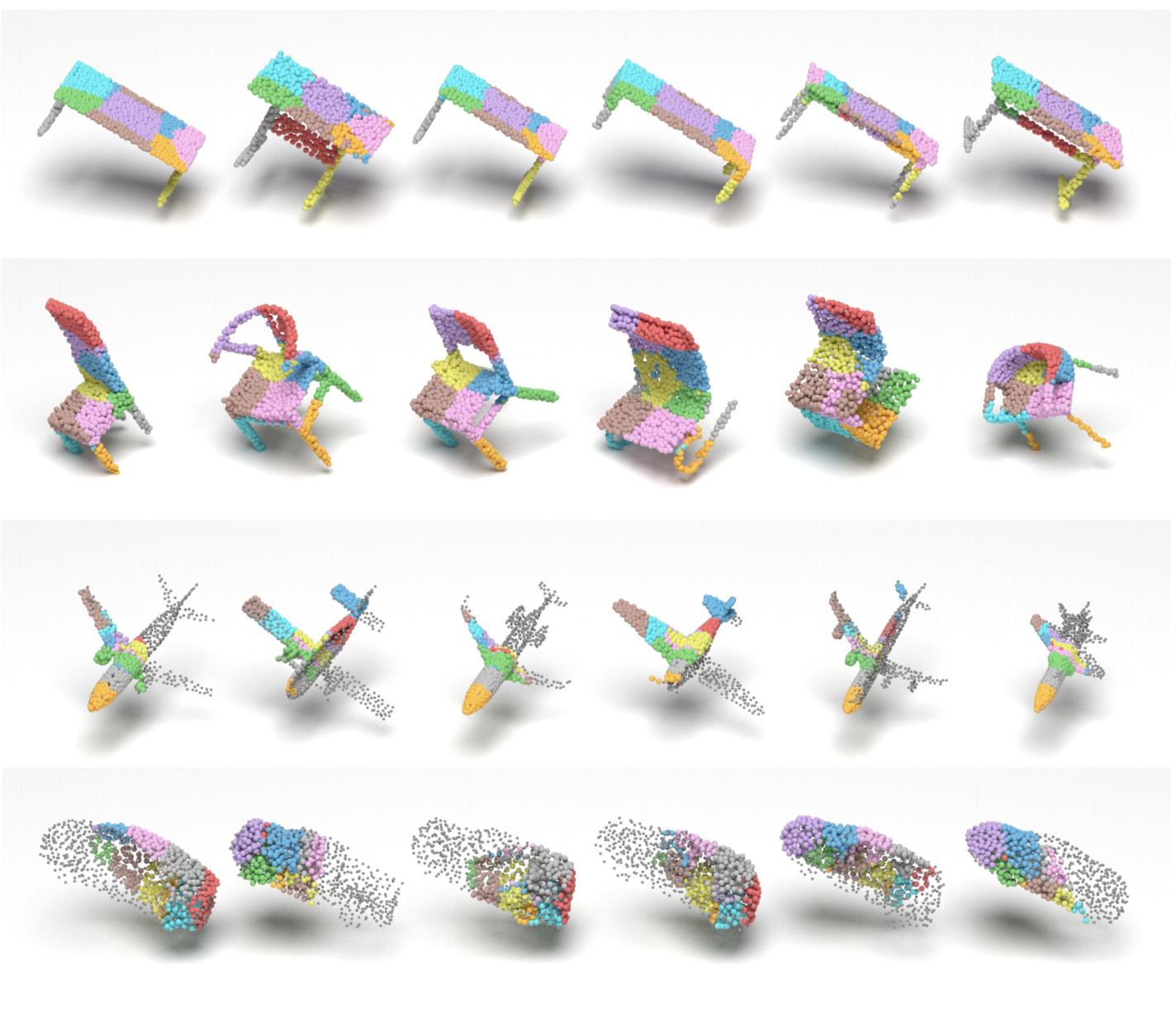 ConDor: Self-Supervised Canonicalization of 3D Pose for Partial ShapesIn Proceedings of the IEEE/CVF Conference on Computer Vision and Pattern Recognition (CVPR), Jun 2022
- SO(3)-equivariant self-supervised 3D pose canonicalization — works on partial point clouds.
- Also performs automatic co-part segmentation as a byproduct.
-
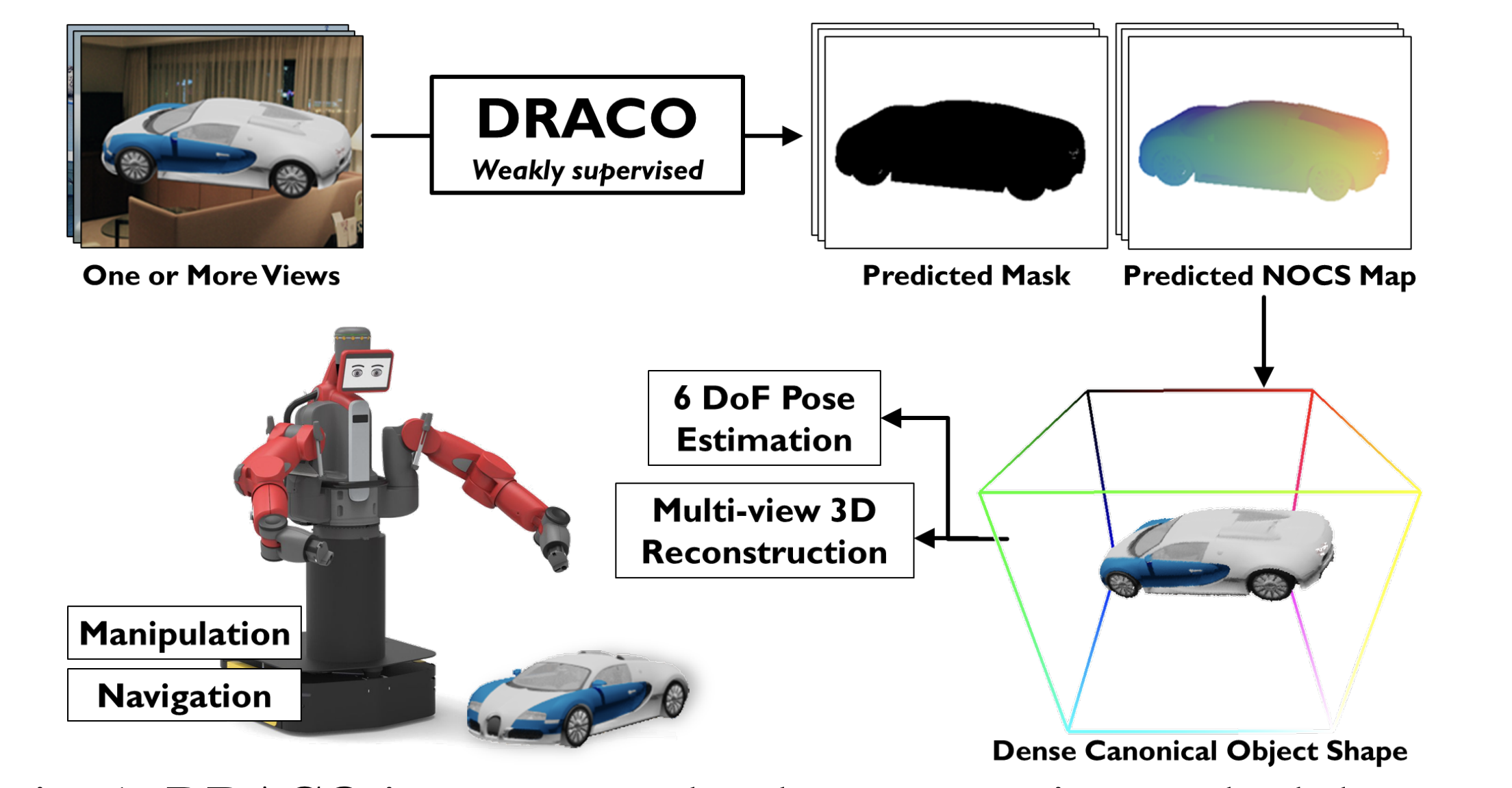 DRACO: Weakly Supervised Dense Reconstruction And Canonicalization of Objects2021 IEEE International Conference on Robotics and Automation (ICRA), Jun 2021
- Weakly-supervised dense reconstruction and pose canonicalization of 3D objects.
- Learned without any 3D ground-truth supervision — IEEE ICRA 2021.